Home renovation finance – however exciting your project may be, this is a big question. How will you actually pay for such a big investment to make your dream home improvement project a reality? Be it expanding a living space, redesigning a kitchen, or creating a loft bedroom, financial planning is one of the most important aspects of dealing with such projects.
As professional mortgage advisers, we have assisted many homeowners with a home renovation mortgage, so let’s look at the options you can consider when planning your extension, design project, or property refurbishment and which might be the best fit for your situation.
As well as financial considerations you might need some creative advice so read to the end to be introduced to our resident interior designer.
NOTE : all interest rates provided are indicative only & are correct at the time of writing. 10/2024. Markets can change quickly & each client circumstance is different so specific terms should be obtained from a qualified adviser.
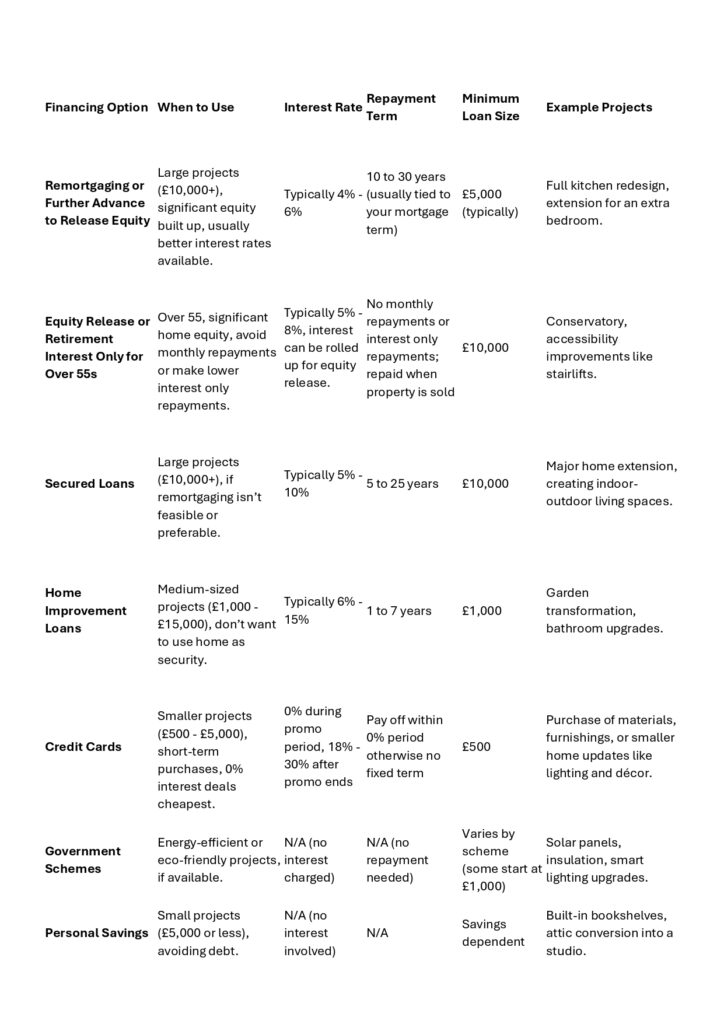
Here is a summary table of our 7 sensible strategies for home renovation finance but keep reading below for more detailed information.
READ ON FOR MORE DETAIL ON OUR SEVEN STRATEGIES FOR HOME RENOVATION FINANCE
Release Equity through a Remortgage or Further Advance
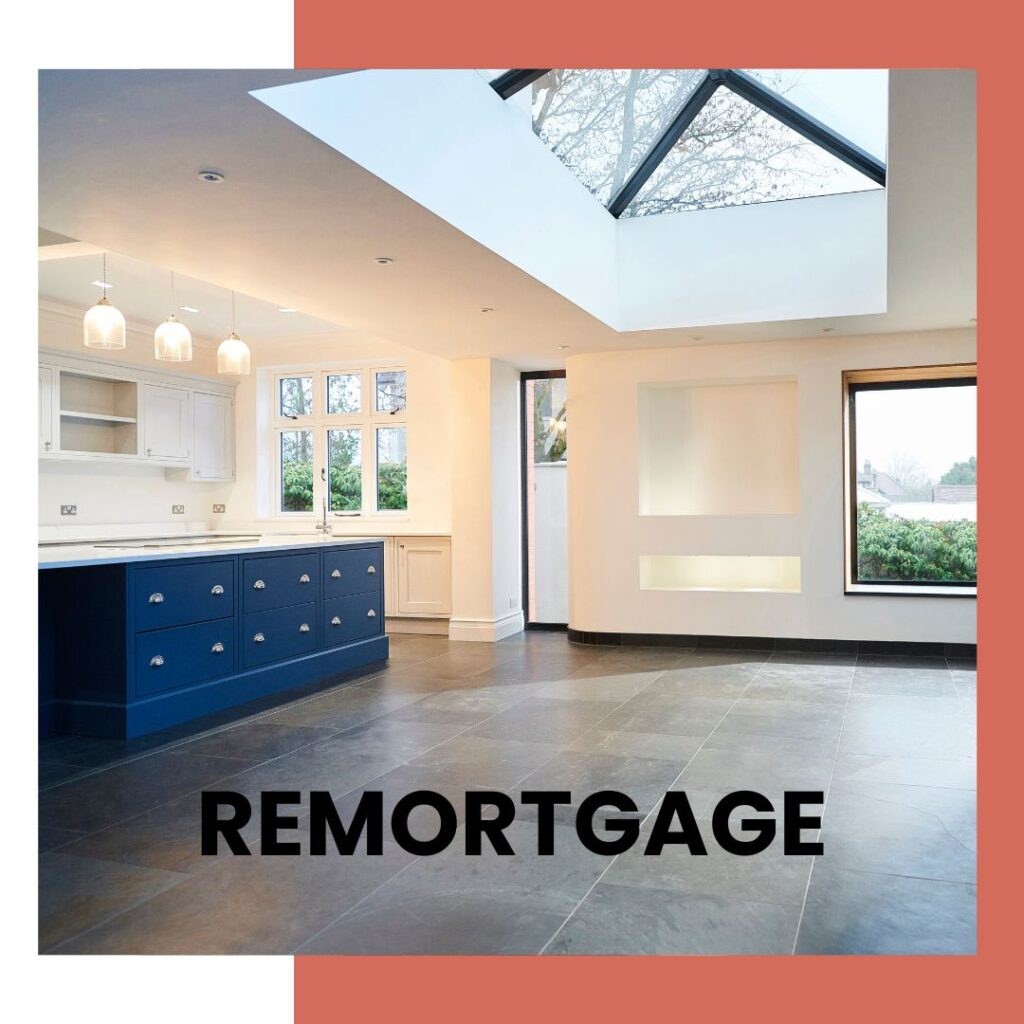
One of the most popular ways of financing a home improvement or interior design project is by re-mortgaging your property to release equity. This, in simpler terms, means that if your home has increased in value since you first purchased it, or you’ve reduced a good portion of your mortgage through your capital and interest repayments, you may be able to borrow additional funds against your property’s value. This can be an affordable way to fund larger projects, such as a full kitchen redesign or an extension to add an extra bedroom.
When to Use a Remortgage or Further Advance for Home Improvements:
Remortgaging can be a great option if you’ve built up substantial equity in your home and you’re planning a large-scale project. Timing is key here however in that you may be tied into a current fixed rate mortgage product and would suffer penalties if your re-mortgaged to a different lender.
If this route would not make financial sense, then you can approach your current lender for a further advance. In this case you would have 2 parts to your mortgage, 1. The original mortgage on the original product & 2. The extra borrowing where you would choose a product from the lenders current portfolio.
In either case, you should seek the advice of a qualified mortgage adviser as there are various factors that should be considered when assessing which route is right, such as timing of the product end dates, the loan to value & by increasing the borrowing the impact on the interest rate you will qualify for, any fees or costs etc.
Remember that your home can be repossessed if you do not keep up your monthly repayments.
Interest Rate: Typically the interest rate on a remortgage will be lower than other loan types, currently ranging from around 4% to 6%, depending on the lender and your credit score. These rates are dependent on current economic & market conditions & will vary.
Repayment Term: The repayment term is usually tied to your mortgage term, which could range from 10 to 40 years, giving you flexibility in spreading the cost over a longer period. The impact of spreading the cost over a long period though is that you will pay more interest over the entire duration of the loan.
Minimum Loan Amount: Usually there is no minimum loan size for a remortgage, but some lenders will impose a minimum £5,000 for a further advance. The maximum loan is restricted based on the loan versus the value of the property and advice should be taken here.
Example: Imagine turning your unused garage into a home office or a cosy guest suite—perfect for modern living and working from home, or you want to create an open plan living space perfect for young families and entertaining.
Equity Release or Retirement Interest Only for Over 55’s
If you’re aged 55 or over, equity release could be an option to access some of the value tied up in your home without having to move. There are two main types of equity release: lifetime mortgages and home reversion plans. This option is often used for larger home renovations, such as adding a new conservatory or making your home more accessible as you age. One advantage is that repayment isn’t required until you sell the house, move into long-term care, or pass away.
Retirement interest only is a special mortgage for over 55’s where you can access funds against your home up to a limit. You still pay a mortgage on this but only interest which keeps the cost lower and more affordable on pension income. The loan does not have an end date & is repaid when the house is sold when you downsize, move into care or pass away.
When to Use Equity Release or Retirement Interest Only for home renovation finance:
Equity release is ideal if you’re over 55, own your home outright or have a small mortgage remaining, and are planning a significant project like making your home more age-friendly. It’s especially useful for those who want to avoid monthly repayments.
Retirement interest only is very similar but you pay the interest monthly subject to it being affordable in retirement.
Interest Rate: Rates for equity release are typically higher than standard mortgages, generally ranging from 6% to 8%. However, the interest is usually rolled up and paid when the house is sold, meaning you won’t make monthly payments.
Rates for retirement interest only are again higher than mainstream lending, generally ranging from 5-8%.
Repayment Term: For equity release no monthly repayments are required—repayment happens when the house is sold or you move into long-term care. For retirement interest only the term is indefinite meaning you can stay in the home as long as you are able without having to get re-approved.
Minimum Loan Amount: For both it typically starts at £10,000, depending on your property’s value and the lender’s requirements.
Example: Use equity release to fund a new conservatory or garden room or to install a stairlift and other home modifications for accessibility.
Rosewood Little Associates are not authorised to provide advice on Equity Release, we will refer you to our trusted specialist.
This is a lifetime mortgage. To understand the features and risks, please ask for a personalised illustration. Check that this mortgage will meet your needs if you want to move or sell your home or you want your family to inherit it. If you are in any doubt, seek independent advice.
Secured Loans
These allow you to borrow money by using your home as security, much the same as a re-mortgage or further advance. This secured home improvement loan would create a second charge on your property, or in other words, the first charge is your mortgage, and the second charge is the new secured loan. This basically means that 2 different lenders have a stake in your property until the loans are repaid. You need to think about how you exit this two -tier lending because, in an ideal world, you would want to combine your mortgage & secured loan in the future with a re-mortgage and lose the second charge. It’s just a little more complex but it could work for your unique circumstances.
Because these loans are secured against your property, you can normally borrow more than with an unsecured loan; however-as with the option of remortgage & further advance-it’s very important to remember that your home may be at risk if you fail to keep up with your repayments. A secured home improvement loan is ideal for larger projects, such as adding an extra floor or a completely renovating your property.
When to Use Secured Loans for Home Renovation Finance:
Secured loans can be a good choice if you need to borrow a significant amount, typically £10,000 or more, and either don’t want to remortgage or your current lender criteria can’t give you what you need (perhaps because your credit profile has deteriorated, or your current lender has lower borrowing limits than you need). They often come with lower interest rates than unsecured loans but can carry heavy arrangement fees.
Again, in this instance you should seek the advice of a qualified mortgage adviser.
Interest Rate: Since the loan is secured against your property, the interest rates are generally lower than unsecured loans but higher than mortgage loans —typically between 5% and 10%, depending on the lender and your credit profile.
Repayment Term: The repayment terms are usually more flexible, ranging from 5 to 25 years, which allows you to manage monthly payments over a longer period.
Minimum Loan Amount: Often starts at £10,000, though this varies by lender.
Example: A secured loan might be the way to go if you’re envisioning a major extension to create a stunning indoor-outdoor living space, complete with bi-fold doors and a new patio area or outdoor kitchen.
Home Improvement Loan
Another no-nonsense option is a home improvement loan. These are typically unsecured loans or personal loans that you can use specifically for home projects, whether you need a garden makeover or fitting in a new bathroom. The interest rates tend to be fixed, making it easier to budget for repayments.
When to Use a Home Improvement Loan:
Home improvement loans are ideal for medium-sized projects where you don’t want to use your home as security. If you need between £1,000 and £15,000, and have a good credit score, this can be a quick and simple way to fund your project without dipping into your mortgage.
Interest Rate: Since a home improvement loan is usually unsecured, the interest rates are higher than remortgages—typically between 6% and 15%, depending on your credit history and the lender.
Repayment Term: Most unsecured loans offer repayment terms between 1 to 7 years, so you’ll have less time to spread the cost compared to a remortgage.
Minimum Loan Amount: Usually starts at £1,000, though some lenders may have a higher minimum for a personal loan.
Example: With a home improvement loan or personal loan, you could design the dream open-plan kitchen with sleek, custom cabinetry, or even install a sunroom that floods your home with natural light—turning your house into a perfect sanctuary.
Credit Cards for Smaller Renovation Projects
While it’s not advisable to fund an entire renovation on a credit card, they can be useful for smaller, more manageable purchases—particularly if you have a 0% interest card. Credit cards can be great for buying materials or furnishings without paying interest over a short-term period.
When to Use Credit Cards for Home Improvements:
Credit cards are best for smaller projects or purchases, typically under £5,000. They’re useful if you have access to a 0% interest deal and can pay off the balance within the interest-free period. Be cautious with higher balances, as credit card interest rates are usually higher than other forms of borrowing.
Interest Rate: If using a 0% interest card, you won’t pay any interest during the promotional period (often 6 to 24 months). However, standard credit card interest rates range between 18% and 30% after the promotional period ends.
Repayment Term: Credit card repayment terms vary, but it’s recommended to clear your balance within the 0% promotional period to avoid high interest charges. There are no fixed repayment terms as with traditional loans.
Minimum Credit Amount: Depending on your credit limit, but typically amounts of £500+ can be funded through a credit card.
Example: Using a 0% credit card, you could complete some minor home designs, such as adding a stylish new dining area with statement lighting and bespoke furniture ready for festive celebrations.
Government Schemes
It’s also worth exploring any government-backed initiatives that may support home improvements. For example, there have been past grants for energy efficiency projects, such as installing solar panels or improving insulation. While these schemes aren’t always available, they can be valuable if you’re looking to make your home more eco-friendly.
When to Use Government Schemes to fund Home Improvements:
If your project includes energy-efficient or eco-friendly elements, always check if there are any current government grants or incentives available. These schemes are great for making upgrades without needing to borrow large sums, particularly for projects like insulation or renewable energy installations.
Interest Rate: Government grants do not typically require repayment, so no interest is charged.
Repayment Term: N/A, as grants do not need to be repaid.
Minimum Grant Amount: Schemes and amounts vary, but some start as low as £1,000.
Example: If you’re dreaming of a modern, energy-efficient home with smart lighting and heating, a government scheme could help fund your upgrade, making your home design both stylish and sustainable.
Personal Savings
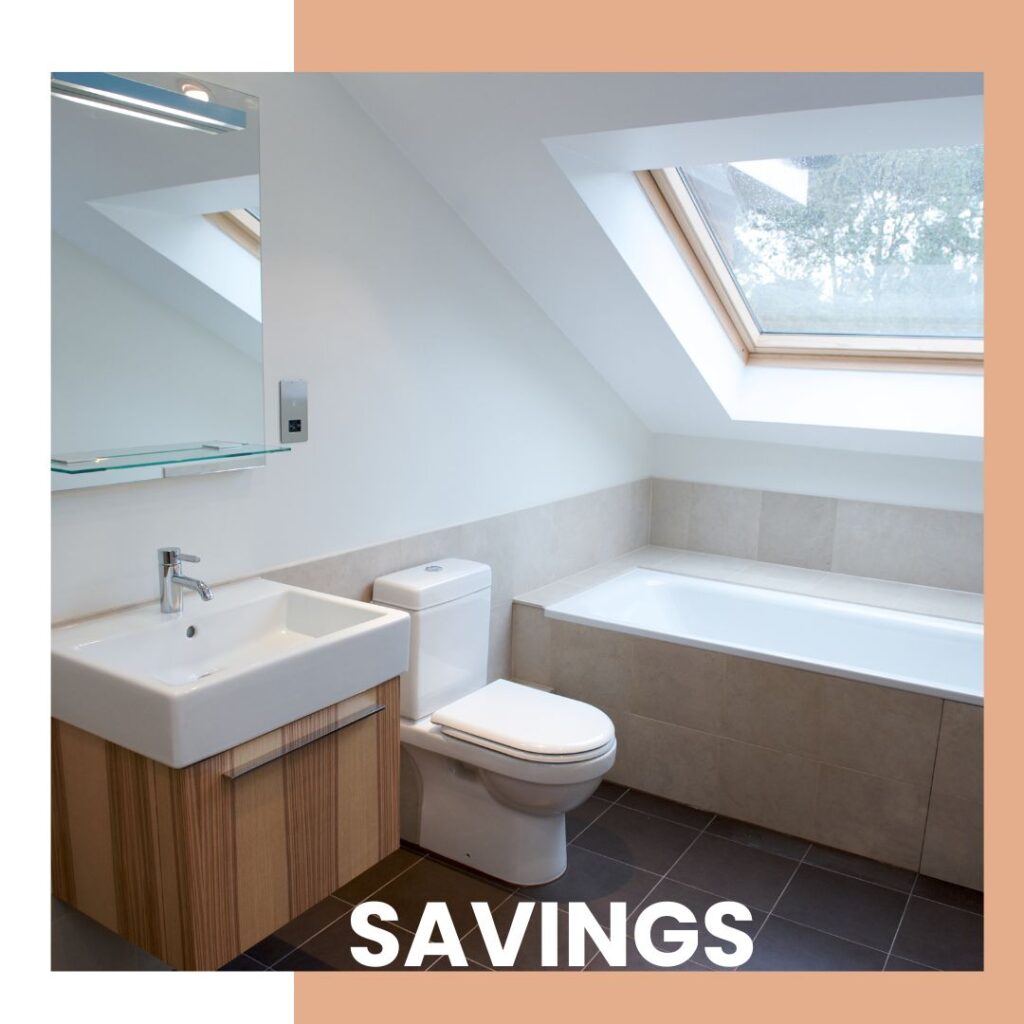
Lastly, dipping into your savings can be a good idea if you don’t want to take on new debt & you have enough left still to provide an emergency fund for your household. Probably more suited to fund smaller-scale improvements. Saving up in advance can also give you peace of mind, knowing you’re not adding financial strain to your household budget.
When to Use Personal Savings to fund Home Renovation Finance:
Personal savings are ideal if you have smaller projects under £5,000, or if you’ve already saved up for your home improvements. This approach avoids the need for loans or credit, keeping your finances clear of additional monthly repayments.
Example: Use your savings to bring your interior design vision to life—whether it’s a bespoke built-in bookshelf for your home library or a loft conversion to create studio space.
Bringing Your Dream Home Renovation to Life – the experts
We appreciate that whilst creating your dream home will be exciting, it can be a little overwhelming, or even daunting, so Rosewood Little Associates Ltd bring you our trusted interior design firm Design@Studio17 so you have reassurance both financially and creatively, its important that you are confident your investment is a wise investment for you now and for years to come.
Financial Expert
Whatever the scale of your project, it’s all about the right financial plan. I can help you as a mortgage broker to steer through options and find the best solution for your specific needs. If done correctly, that renovation dream could finally come true.
Interested in learning more about financing your project? Get in touch below for tailored advice.
YOUR HOME (OR PROPERTY) MAY BE REPOSSESSED IF YOU DO NOT KEEP UP REPAYMENTS ON YOUR MORTGAGE OR ANY OTHER DEBTS SECURED ON IT.
Creative Expert
Design@Studio17 is a Manchester-based interior design studio serving clients across the UK. They specialise in a variety of home design services tailored to bring your unique vision to life. The studio recognises that successful design is about more than aesthetics — it’s about ensuring each room and space in your home functions as intended, whether that’s creating a sanctuary for relaxation, a hub for hosting, a productive workspace, or a seamless combination of all three. By understanding your personal needs, they curate home designs that not only reflect your current lifestyle but also serve as a timeless investment for the future.
Whether you’re planning to renovate a single room or take on a more extensive project, Design@Studio17 offers flexible solutions to suit your needs. For homeowners comfortable managing their own home improvement projects, they provide virtual design services, allowing you to progress at your own pace with online meetings. This service is perfect for those who want creative guidance but prefer to handle the hands-on work themselves.
Additionally, if you’ve already started your design journey but hit a creative block — or if you need expert advice to avoid costly mistakes — their Creative Studio consultancy is available. Charged by the hour, this service offers tailored guidance to help with mood boards, sustainable material choices, lighting schemes, spatial planning, and room layouts. It ensures your home not only looks great but also improves your well-being by maximising the use of space.
For clients who prefer a more hands-off approach or are working on larger projects, Design@Studio17 offers full-service design packages. These comprehensive services manage every detail from start to finish, ensuring your vision is fully realised.
You can find out more about their residential interior design services here or reach out via their contact form — they’re ready to support you at every stage of your design journey.